


In this concise booklet, author Timothy Paul Jones addresses the doubts and questions that arise from Jesus’s resurrection as recorded in the New Testament. Jones argues this story is not a mere repetition of old pagan tales or a fabrication to fulfill Jewish expectations. Instead, it was a historical event, and that is supported by compelling evidence, including accounts of men and women who were willing to die for what they believed they had seen.
The Bible tells us that the congregation gathered around God’s heavenly throne will be “a vast multitude from every nation, tribe, people, and language,” all singing the praises of the Lamb. God’s intention has always been to delight for all eternity in a redeemed community of ethnic diversity. But this diverse community shouldn’t have to wait until eternity to begin! It can be a reality in our own local churches here and now. Patterned after a worship service, In Church as It Is in Heaven gives biblical warrant for such a community and shows how multiethnic churches provide a unique apologetic for the gospel. Along the way, the authors tell the story of their own church. Multiethnic kingdom culture is not just a nice idea, or an abstract theory. It’s a reality―one we can enter into today.
“What good does it do to say that the words [of the Bible] are inspired by God if most people have absolutely no access to these words, but only to more or less clumsy renderings of these words into a language?”
So contends Bart D. Ehrman in his bestselling Misquoting Jesus. If altogether true, we have little reason to put our confidence in Scripture. Add to this Ehrman’s contention that what we read in the New Testament represents the winners’ version of events, twisted to suit their own purposes and not at all a faithful recounting of what really happened, and the case for skepticism and unbelief gives every appearance of being on solid footing. But are things really so bad off?
God has called Christians to be prepared to defend their hope in Christ, but what’s the best method for making this defense? In this book, five expert apologists set out together to determine which approach to apologetics is the most faithful to Scripture and the most useful in a secular age.

Many people think that the Bible is a cobbled–together selection of ancient writings that have been changed so many times over hundreds of years that surely the text can no longer be trusted.
In this new book, Timothy Paul Jones admits that the Bible is a difficult book to believe. Still, Jones makes the case that belief in the Bible is far from unreasonable. Written for people who are skeptical of the Bible’s accuracy and authority, this book takes a reasonable look at common questions and doubts about the Bible.
Have you ever wondered who wrote the books in the Bible and how they ended up together? Has anyone ever told you that some books were cut out of the Bible or that the stories of Jesus in the Gospels can’t be trusted? In this book, dive into the fascinating account of the most amazing and best-preserved book the world has ever seen. Dr. Timothy Paul Jones gives easy-to-understand answers to popular questions in the book and study curriculum How We Got the Bible.
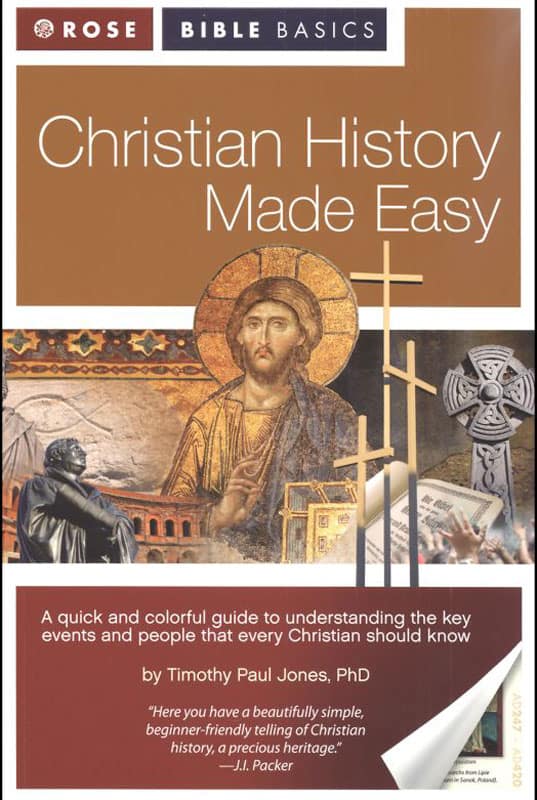
This fantastic book summarizes the most important events in Christian history from the time of Jesus to today in 12 easy chapters. This full color, bestselling book presents key events and people every Christian should know, time lines, worksheets, websites, photos, maps and illustrations. A leader’s guide makes this book an excellent study for any group, including new believers’ classes. The great theologian J. I. Packer says thatChristian History Made Easy is, “a beautifully simple, beginner-friendly telling of Christian history, a precious heritage.”
In Perspectives on Family Ministry, Timothy Paul Jones makes the case that every church is called to some form of family ministry—but what he means by “family ministry” isn’t simply one more program to add to an already-packed schedule! According to Jones, the most effective family ministries involve refocusing every church process to engage parents in the process of discipling their children and to draw family members together instead of pulling them apart.